
How Heavy Should Your Dumbbells Be?
One of the first things I had to figure out when getting back into strength training was what weights I should actually be using. It sounds like a simple question until you’re standing there with a few pairs of dumbbells trying to decide whether the weight in your hand is challenging enough, too heavy, or embarrassingly light.
If you used to work out, there’s another problem too. You probably remember what you used to lift.
It’s tempting to use those numbers as your starting point, especially when you know you’ve lifted that weight before. But after months or years away from consistent strength training, what you used to lift doesn’t really matter. You’re trying to find the right weight for the strength you have now.
The good news is that you don’t need a calculator or a perfectly prescribed weight for every exercise. Your body gives you quite a bit of information if you know what you’re looking for.
There isn’t one correct dumbbell weight
I think this is the first thing that makes choosing dumbbells confusing. We want someone to tell us, “If you’re a beginner, use 8-pound dumbbells,” as though that solves the problem.
It doesn’t.
An 8-pound dumbbell might be plenty for an overhead press and far too light for a squat. You’re probably going to be able to row more than you can lateral raise, and your legs can generally handle considerably more weight than smaller muscles in your upper body.
The exercise matters, but so do you. Your previous training experience, current strength, the number of repetitions you’re doing, and even how comfortable you are with the movement can all affect the weight that makes sense.
That means you probably won’t have one pair of dumbbells that’s perfect for your entire workout. If you’re working out at home and only have one or two pairs right now, that’s fine. You can work around it while you figure out what you’ll eventually need.
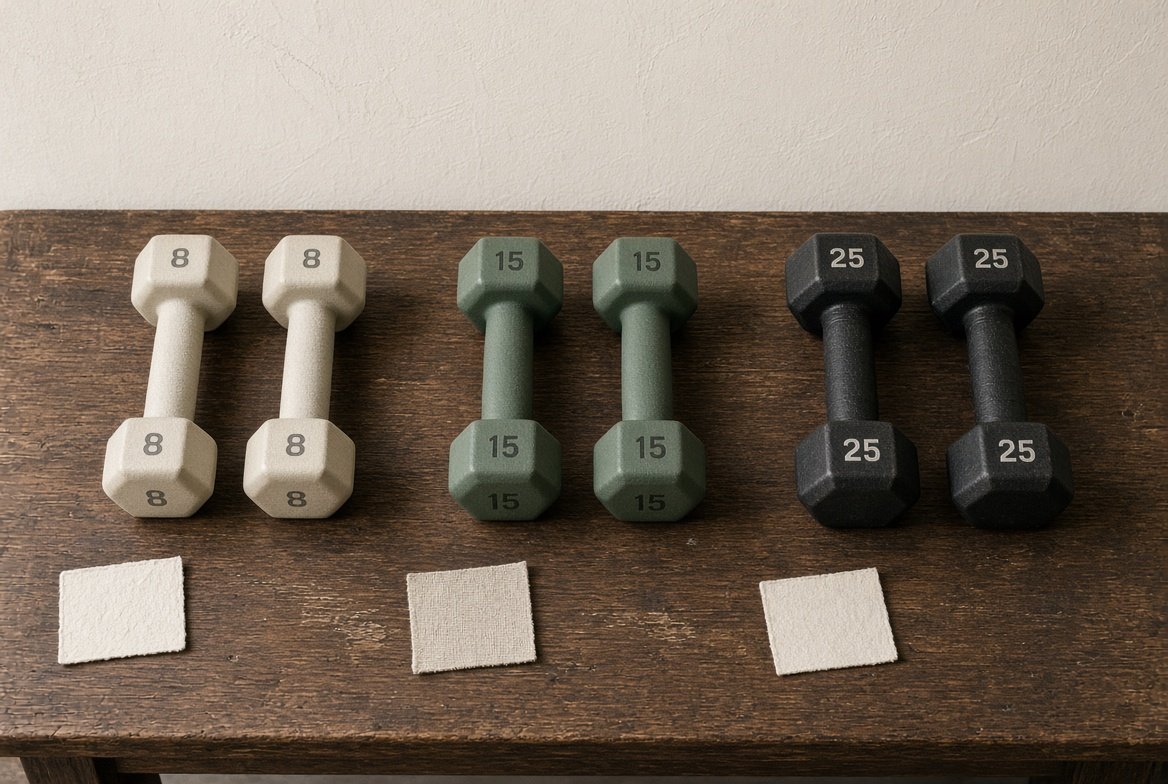
Start lighter than you think you need
If you haven’t strength trained in a long time, I’d rather start too light than too heavy.
You’re not only testing how much weight you can physically move. You’re getting used to the movement again, paying attention to your form, and finding out how your body responds afterward. A weight that feels completely manageable during your first set can feel very different by the end of your workout.
This is especially true during your first week back. Your muscles are being asked to do something they haven’t had to do regularly in a while, so you don’t really know how sore or fatigued you’re going to be the next day.
Starting lighter gives you room to figure that out. If the weight turns out to be much too easy, you can increase it during the next set or the next workout. There’s no downside to spending one workout using a weight that was a little lighter than necessary.
Going much too heavy has a bigger downside because your form can fall apart and you can end up so sore that your next planned workout doesn’t sound remotely appealing.
The last few reps should feel harder
This is probably the easiest way I’ve found to judge whether a dumbbell is in the right general range.
Let’s say your workout calls for 10 repetitions of a dumbbell row. The first several reps should feel pretty comfortable, but as you get toward eight, nine, and ten, you should have to work harder. You should still be able to control the dumbbell and keep good form, but you should be glad the set is almost finished.
If you get to ten and genuinely feel like you could do another ten or fifteen without much trouble, the weight is probably too light for that exercise.
On the other hand, if you’re supposed to do ten reps and your form starts falling apart at five, it’s probably too heavy. You shouldn’t have to throw the weight around, shorten the movement, or recruit half your body just to finish the set.
There’s a middle ground where the exercise is challenging without becoming sloppy. That’s what you’re looking for.
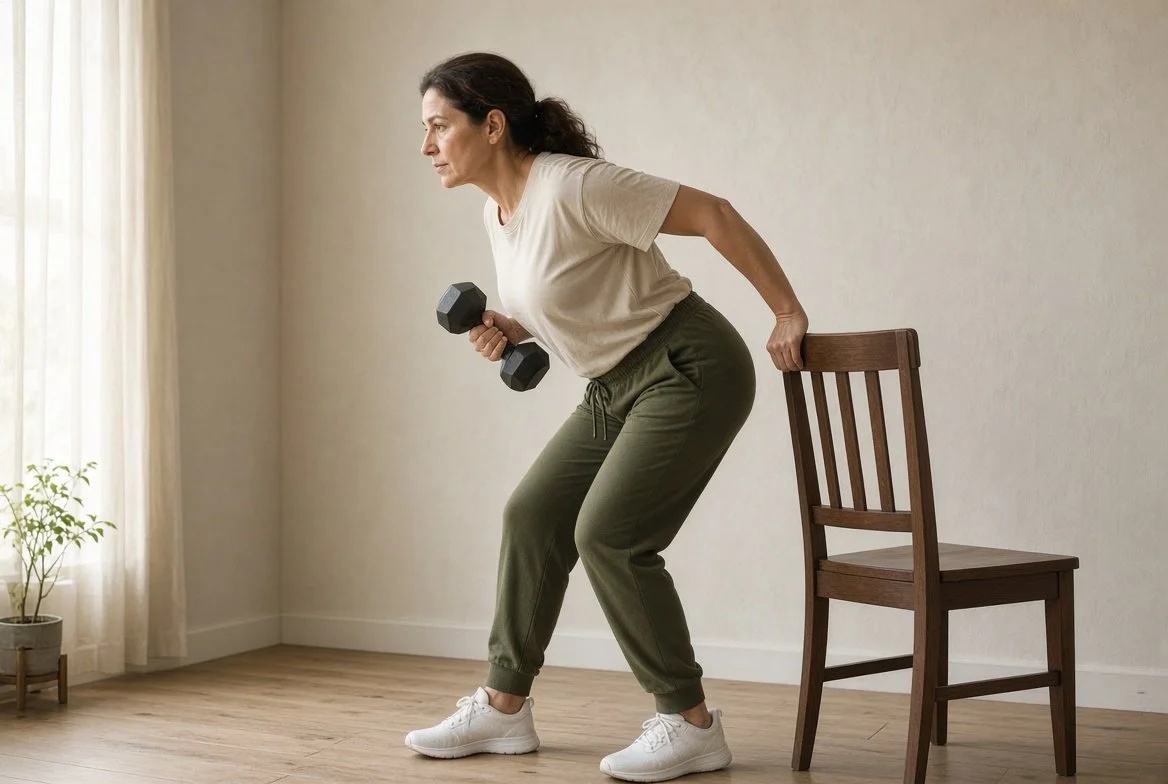
“Could I do a few more?” is a useful question
You may hear people talk about “reps in reserve,” which is basically a way of estimating how many more repetitions you could’ve done before you physically couldn’t complete another good rep.
You don’t need to get overly technical with it when you’re getting back into strength training. I think a simpler question works: Could I have done a few more good reps?
If the answer is yes, maybe two or three, you’re probably in a pretty reasonable place. If you could’ve kept going forever, you can probably increase the weight. If you couldn’t have done one more rep without your form falling apart, you may be pushing harder than you need to right now.
You also don’t need to train until you physically can’t do another repetition to make progress. Especially when you’re coming back after a long break, leaving yourself a little room is a perfectly good way to train.
You’re trying to build strength over the next several months, not find out how miserable you can make one Tuesday afternoon.
Your form gets the final vote
There’s a difference between an exercise getting difficult and an exercise getting messy.
If the last couple of squats are slower because your legs are working hard, that’s one thing. If you’re losing your balance, your movement has completely changed, or you’re cutting every squat shorter because you can’t control the weight anymore, that’s useful information.
The same thing happens with upper-body exercises. If you’re doing an overhead press and suddenly you’re arching your back dramatically and using your whole body to get the dumbbells overhead, the weight has stopped being appropriate for the movement you’re trying to do.
That doesn’t mean you failed the exercise. It just means you found the point where you need to stop, lower the weight, or end the set.
There’s also a difference between muscles working hard and actual pain. Muscles burning or feeling tired during a set can happen. Sharp, sudden, or unusual pain isn’t something I’d try to push through just to finish the prescribed number of reps.
You’ll probably need several dumbbell weights eventually
If you’re working out at home, this is where things can get slightly annoying. Once you start getting stronger, one set of dumbbells usually isn’t enough.
For example, you might need a relatively light pair for shoulder exercises, something in the middle for presses and rows, and considerably more weight for squats and deadlifts. That gap tends to become more noticeable as your legs get stronger.
You don’t need to buy an entire dumbbell rack before you start, though.
Use what you have first. That gives you a chance to see where your actual gaps are instead of guessing what weights you’ll need. Adjustable dumbbells can also make sense for home workouts if you want access to a larger range without storing a bunch of individual pairs.
And if all you have right now is a light pair of dumbbells, you can still start. Slower repetitions, additional reps, pauses, and certain single-leg or single-arm exercises can make lighter weights more challenging while you build up your equipment.
Equipment shouldn’t become another reason you have to wait until everything is perfect.
When should you move up to a heavier dumbbell?
You don’t need to increase your weights on a schedule. You increase them when the weight you’re using stops providing enough challenge.
Let’s say you started doing goblet squats for 8–10 repetitions. At first, ten reps took some effort. After a few weeks, you can do all ten with good form and finish feeling like you could easily keep going.
That’s a pretty good sign that it’s time to try something heavier.
The next dumbbell might feel noticeably harder at first, and you may not be able to do as many reps with it. That’s okay. You could do eight controlled reps with the heavier weight and work your way back toward ten.
You can also progress without immediately buying a heavier dumbbell. If you were doing eight repetitions, try ten. If you were doing two sets, you might eventually add a third. You can slow the movement down or add a pause at the hardest part.
Adding weight is one way to make an exercise harder, but it isn’t the only way.
Write down what you’re lifting
This is something I think is worth doing even if you have absolutely no interest in becoming someone who tracks every detail of every workout.
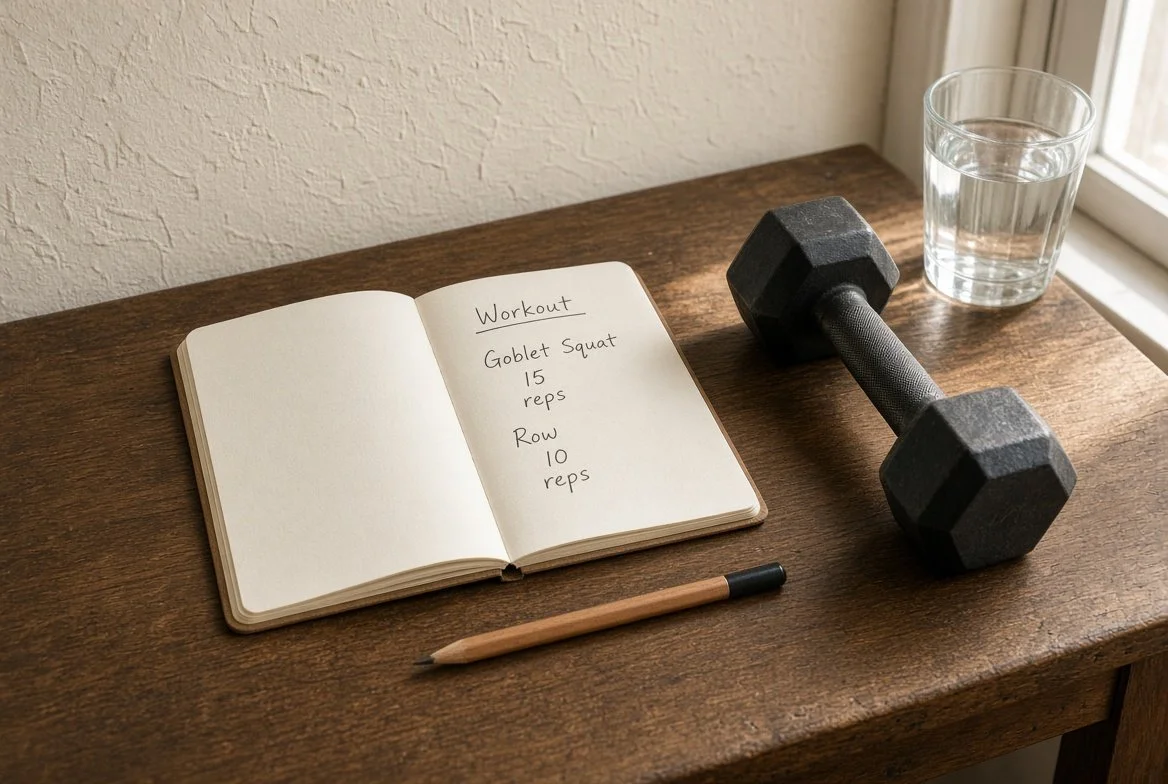
Write down the exercise, weight, and roughly how many reps you did. It can be in your phone, a notebook, or wherever you’ll actually look at it again.
Otherwise it’s surprisingly easy to spend weeks picking up the same dumbbells because they seem about right. If you know you did 10 goblet squats with 15 pounds last week and it felt pretty easy, you have a reason to try 20 this week.
It also gives you another way to see progress that has nothing to do with the scale.
When you’re getting back into fitness, physical changes can take time. Being able to look back and see that you’re rowing more weight, doing more controlled repetitions, or using a heavier dumbbell for squats is proof that something is changing even if you can’t see all of it in the mirror yet.
I like that kind of progress because it’s difficult to argue with. Fifteen pounds used to be hard. Now it isn’t.
You got stronger.
Don’t worry about whether the dumbbell looks “too light”
I think this matters particularly when you remember being stronger.
There can be a weird amount of ego attached to picking up a smaller dumbbell than you think you should need. A knee push-up can feel like it doesn’t count because you remember doing regular push-ups. Five-pound dumbbells can feel silly because you remember using fifteens.
But your body doesn’t care what number is printed on the side of the dumbbell.
If five pounds challenges your shoulders today, then five pounds is doing its job. If you need to put your knees down to do controlled push-ups, that’s the version of the exercise that makes sense right now.
The whole point of getting back into strength training is that those things won’t necessarily stay your starting point.
Use the weight you can control. Get your reps. Recover. Come back and do it again. When it gets easier, make it a little harder.
That’s how you eventually end up needing the heavier dumbbell.
And that’s a lot more useful than picking it up before you’re ready just because you remember a time when you could.
Not sure where to start?
If you’re getting back into exercise after some time away, Get Moving: Your First Week Back gives you three full-body dumbbell workouts with recovery days between them.
You can use that first week to figure out what weights feel right for different movements without jumping straight into a complicated workout schedule.
[GET THE FREE 3-WORKOUT PLAN →]
Start where you are. Build from there.